One of my biggest pet hates in sales has always been that ridiculous phrase:
“I could sell ice to an Eskimo.”
Years ago, I was running a sales training session. Probably 20 or 30 people in the room. And one bloke proudly announced:
“You can’t teach me anything. I’m the type of salesman that can sell ice to Eskimos.”
And honestly… I went straight off on one.
Because no. You can’t.
Or at least, you shouldn’t want to.
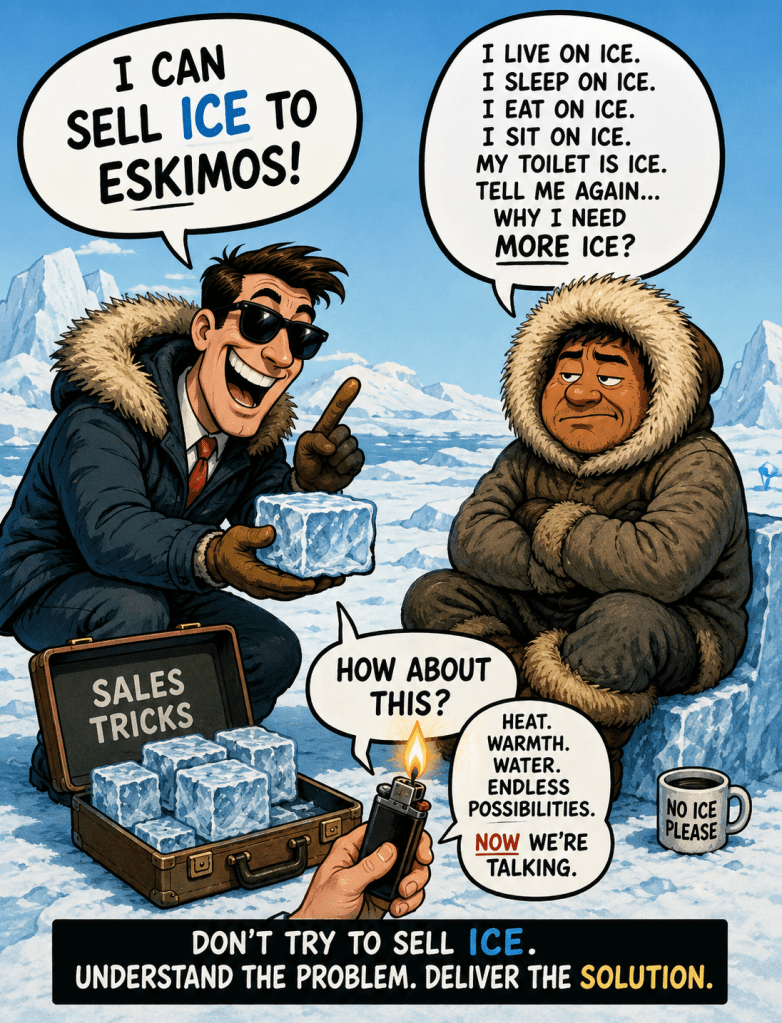
So I stopped the session and said:
“Alright then. Sell me ice.”
“I’m an Eskimo.
I sit on ice.
I sleep on ice.
I live surrounded by ice.
Every direction I look for the next hundred miles is ice.
So tell me exactly how you’re planning to sell me more ice?”
And he completely fell apart.
Because the whole phrase is nonsense.
But more than that, I actually think it says something quite arrogant about the way some people view sales.
Because if you genuinely believe that being brilliant at sales means convincing someone to buy something they clearly don’t need, then what you’re really saying is:
“I think my customers are stupid.”
And that’s probably the worst mindset you can possibly have.
People are not thick.
In fact, one of the biggest mistakes salespeople make is assuming they’re the cleverest person in the conversation.
Most of the time, they’re not.
Customers usually know far more than you think they do.
They know when they’re being worked.
They know when something feels forced.
They know when someone’s reading from a script.
And they definitely know when someone is trying to manipulate them into buying pointless crap.
You might get away with that once.
But trust me — nobody gets manipulated repeatedly forever.
Eventually people feel it.
And once trust has gone, it’s game over.
That’s why I’ve always believed real sales has far less to do with talking… and far more to do with listening.
Actually no — not even just listening.
Observing.
Watching.
Understanding.
Because sometimes customers don’t even tell you directly what the problem is.
Sometimes you have to properly see it.
And that’s where the Eskimo story changes completely.
Because no — you probably can’t sell him more ice.
But imagine this.
You notice he’s surrounded by frozen water.
You notice the challenge isn’t lack of ice…
it’s what the ice stops him doing.
And suddenly you reach into your pocket and pull out a lighter.
Now we’re talking.
Now you’ve got something genuinely valuable.
This tiny little thing suddenly:
- creates heat
- melts ice into water
- provides warmth
- creates possibility
- solves problems
So imagine what that lighter becomes worth to the Eskimo.
Probably far more than the ice ever was.
And I think that’s the difference between bad sales and great sales.
Bad sales is trying to force people to want what you’ve already decided to sell.
Great sales is understanding people well enough to recognise what actually improves their life, solves their problem, removes stress, creates opportunity or makes things easier.
That’s why the best salespeople I’ve ever met were rarely the smoothest talkers.
They were the people who:
- listened properly
- paid attention
- understood human behaviour
- noticed frustration
- spotted gaps
- recognised emotional needs as well as practical ones
And then connected the right thing to the right person.
Not manipulation.
Not trickery.
Not “hard closing”.
Just understanding people properly.
Ironically, the people most obsessed with “sales tricks” are often the weakest salespeople of all.
Because if your whole strategy relies on being smarter than your customer, eventually you’ll meet customers smarter than you.
Whereas if your strategy is built around genuinely understanding people, solving problems and creating value, you never really need to “sell” in the traditional sense anyway.
People naturally move towards things that make sense to them.
Which is exactly why you should stop trying to sell ice to Eskimos…
…and start figuring out who desperately needs a lighter.


Leave a Reply