Framing is all about how we look at things… how we present them… how we frame them!
Is a glass half full or half empty?
Take an empty glass and fill it half way: 88% will say it’s half full
Take a full glass and pour half away: 31% will say the same
On a study where doctors considered the merits of surgery:
Those that were told 10 out of 100 died… 50% considered it a good option
Those that were told 90 out of 100 survived… 84% considered it a good option
Framing! Same data… presented differently completely changes our perception.
So consider your framing; it’s not the data… it’s how we present it that makes the difference. How are you presenting right now? And could you frame it better?
Here’s a thought:
1) you’re at a car boot sale: you see a vase you like… what do you expect to pay?
2) same vase: mid range department store… what are you paying here?
3) it’s a 1-off at an exclusive antique store in Knightsbridge.. what would you pay?
I’m imagining your value is completely different in each of my scenarios?
Now consider:
1) boot sale vase… bet you’d never even put it on display (just when you receive a bunch of flowers out of the blue and have no other vessel)
2) department store vase… bathroom or kitchen display maybe?
3) Knightsbridge exclusive 1 off vase.. pride of place at all times right?
Same vase… our value for it completely changes based simply on framing!
The first time I wrote about this topic I was sat by a pool in Majorca surrounded by fake Gucci, Prada and YSL… and certainly right there the strength of framing hit me…
Framing is vital: so always present yourself, your business, your product with the best content, with the most power and giving the maximum impact!
So today I’m talking about my favorite subject; listening!
Starting with the true basic of sales… the dreaded 2 ears 1 mouth quote. You should listen for twice as long as you talk…. Because we all know that the best sales people are good listeners rather than good talkers.
You need to put an end to conversational narcissism if you want to achieve more.
The spotlight should always come back to your client and I’ll tell you why.
(And surprisingly; it’s not just that we’ll find their hotspot if we let them talk and we listen more.. actually it’s even bigger than that).
Have you all heard of the Amygdala?
It’s a part of our brain that sits in our temporal lobe within our limbic system that controls emotions and fear. (It’s shaped like an almond .. no real relevance to that except Amygdala is Latin for Almond… in case you care!)
Anyway; if you were on a little trek in the woods and a bear suddenly jumped out at you; before you could even say; ‘oh crap, that’s a bear’… your amygdala would be instantly alerted and this would trigger your fight, flight or freeze response!
When this happens it dampens down many other parts of your brain so it can focus single handedly on saving your skin.
One of the areas it disrupts is the prefrontal cortex; this is partially responsible for listening: it’s the part of your brain that puts everything together for the purpose of rational thinking and decision making.
So if we want our clients to hear us properly, think rationally and make a good decision; we need their Prefrontal cortex fully mobilised so we need that amygdala to pipe down!
Our amygdala is inactive and quiet when we feel safe and our prefrontal cortex is fully active under these conditions.
To feel safe; we don’t just need to be bear-free. Interestingly; studies have shown that when deeply held beliefs are challenged; this triggers the amygdala in exactly the same way as a physical threat would. So there is good reason to avoid; politics, religion and any such other strong beliefs in fact; anything controversial or confrontational!
To feel safe; we need to feel understood.
To feel safe; we need to feel that we matter & are important.
To feel safe; we need to feel listened to.
If we can put our clients in a position where they feel safe; then they are
1) more likely to actively listen
2) less likely to be defensive
3) more likely think rationally
4) more likely to make a good decision
5) more likely to buy today
If we put our clients in a position where they don’t feel safe then their amygdala will be active and they will likely flit into fight, flight or freeze!
Remember how we ALL feel about sales people; we’re ALL scared that we’ll be tricked into buying something we don’t want… We all run when we see those clipboard people in the high street!
Are you a fight? – ‘I don’t need that, go away’
Are you a flight? – ‘I’m sorry I’ve got to run, I’m late’
Are you a freeze? – pretend to be on your phone! You know who you are!!! 😂
So be aware that we’re often going in on the back foot… their amygdala is already alert as soon as they realise we are there to sell them something so what can you do today to dull that amygdala?
Communication is the greatest skill any of us could have in life: it means better relationship’s, friendships and the best communicators excel in all sides of life.
Communication is the most valuable skill that will enhance every part of our lives. So this week I’m asking you all to take a moment to consider your ‘Vocal Image’.
We all spend a lot of time on our visual image; the way we look, the way we dress, our hair etc but have you considered your vocal image? What are you projecting?
We can change the way we look… Easy right? A change of clothes… lose weight, put on weight… surgery maybe… all possible… some easier than others but all possible.
But can you change your vocal image? I’ll ask you another question; is it possible to change a behavior? Of course it is… although some behaviors are easier to change than others (just like our visual image) but again… all possible!
The way you currently speak is simply a series of learnt behaviors. We have this attachment to our natural ‘authentic’ voice… but I ask you to try playing with your voice: higher, lower, accent… be silly. You’ll feel silly and you’ll say ‘Heids, this isn’t me… it’s not my natural voice’.
So again (my favourite word) reframe that thinking… You’ve already lost your ‘natural’ voice.
The last time we all had our ‘natural voice‘ was at the age of 2 before we were impacted by external influences. The voice you have now is your habitual voice.. accents, projection, phrases, noises… all built based around the people we were surrounded by growing up. We’ve built ourselves a series of habits, a series of engrained behaviors. It’s difficult to change because we’ve been replaying these behaviors for 10, 20, 30, 40, 50 years. But I ask you again… can we change behavior?… the answer is yes.
So consider your favourite speaker, actor, singer, performer… what makes them special? Do you have that showmanship? Let’s work on that….
Changing your vocal image is absolutely possible:
Step 1 is to detach yourself from the habit… realise that you just picked them up… you didn’t choose them… you adopted them… and randomly
Step 2 Be aware of what your habits are and which are serving you and which are limiting your potential(Do we all need the same accent?-no… but if our accent is so strong that it hinders other peoples comprehension then it’s limiting us so we need to work on our annunciation or pace to ensure we are effective communicators)
Step 3 Learn the more impactful habits that will serve us better and influence the people around us… this time build your habits with more intent (leave random behind)
So how do YOU work on YOU? (You’ll likely hate me for this!)
Record a 5 minute video of yourself on your phones… ideally standing up… and just speak. Don’t script… don’t plan… just speak. Any subject you like… not a work one because you want to see you natural.
Then I want YOU to review it… in 3 ways:
1) Turn the volume up… place the screen down on the table so you can’t see it and simply listen – conduct an AUDITORY REVIEW(Are you stuck in 1 volume, are you too quiet, too loud, emotion, pausing, speed??? Take notes)
2) 2nd time: Mute it and just watch yourself – conduct a VISUAL REVIEW (Movement; too little, too much, hand gestures, emotion, happy, grumpy, blank, visual ticks: playing with your hair/glasses? Take notes.
3) Then Have it transcribed (make sure you include the filler words and sounds you make) and complete a TRANSCRIPTION REVIEW. Print out the transcript and literally highlight all your filler words and noises. These are awful btw for your communication… they distract from your message, rob you of authority and lack clarity and credibility. You know the ones……’Errr, you know, err, like, and, you know what I mean, ummm, yeh, err, you know right, like, errr, right, like, errr and all that, and that, you know’.
Once you’re aware of your verbal ticks: every time you hear yourself say one … it will be like an alarm bell in your head… you’ll drop them quickly and learn not to fill the silence… but use it!
Remember, a pause is much more powerful than an ermmmm!
What this should show you is that; we can all improve our communication: it’s just a skill that we all can learn and develop by adopting new behaviors. .
What will you be working on?
Visually: hand gestures, movement, facial expressions, emotion
Auditory: Pace, projection, volume, more vocal variety, energy
Had a tough week this week, well if I’m honest; the whole year has not been the best… in my books 2025 can ‘do one’! 😜
So I’ve decided to tell you (and to remind myself of) my favorite short story by I believe Jon Gordon.
One day a young lady who was overwhelmed; flattened by the constant fight and struggle and dealing with one problem after another turned to her mother for advice.
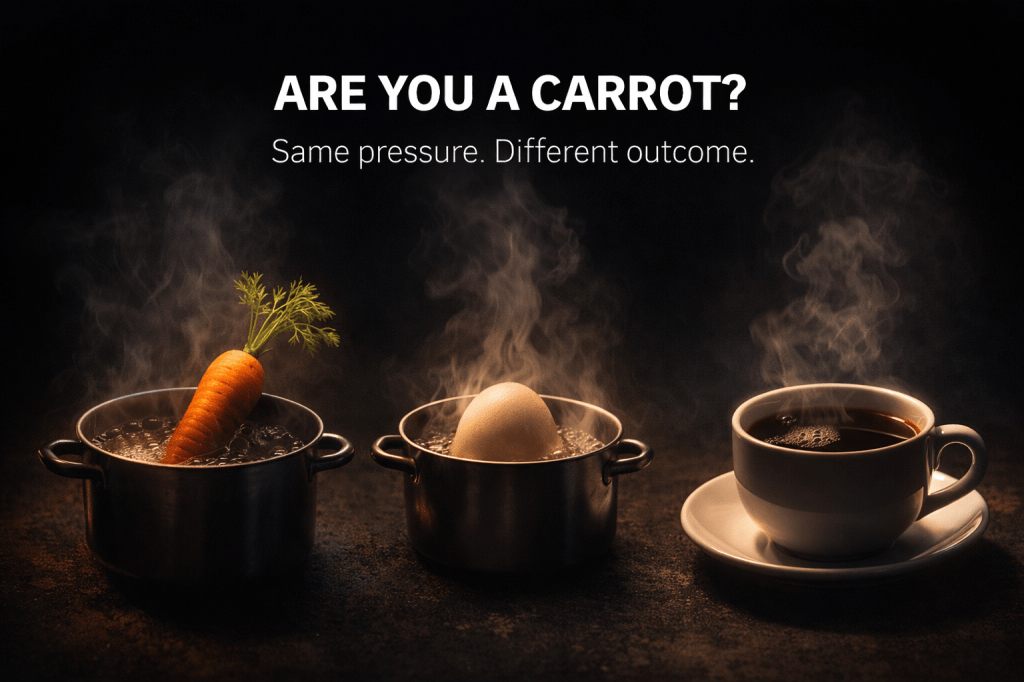
Her mum took her to the kitchen. She filled three pots with water. In the first, she placed carrots, in the second she placed an egg, and the last she placed ground coffee beans.
She let them sit and boil without saying a word. In about twenty minute she turned off the hob. She took the carrots out and placed them on a plate. She pulled the egg out and placed it in a bowl. Then she poured the coffee into a cup. Turning to her daughter, she asked, ‘Tell me what you see?’
‘Carrots, an egg, and coffee mum, what’s your point?’
Mum asked her to touch the carrots: noting they were soft. She got her to break the egg: yes it was clearly hard-boiled. Finally, she asked her to taste the coffee. Delicious.
Mum replied ‘These objects all faced the same adversity – boiling water – but each reacted differently. The carrot went in strong and hard but came out soft and weak. The egg had an outer shell that you’d think would protect it but actually the boiling water has meant that its inside have become hardened and unchangeable. The ground coffee is unique… of course it’s changed, but notice it’s altered the water too and for the better: the aroma has filled the room and as we drink it; we’ll be filled with energy’
So, which are you?’ she asked her daughter.
When adversity knocks on your door, how do you respond? Are you a carrot, an egg, or a coffee bean?’
So this morning as you sit to drink your morning coffee; let’s consider how we face life…
Am I the carrot that seems strong, but with a challenge, a bit of pain and adversity, I wilt, become soft and lose my strength?
Am I the egg that starts with a soft heart, but changes when things get tough? And although on the outside I remain the same: inside I’ve changed and I’ve become hardened and ready to crack.
Or am I like the coffee bean? I change with my environment and force the environment to change with me; I release my true flavour and thrive when others wilt. Am I the one that infuses my environment AND Together we both become better!
Ask yourself…. AM I A CARROT, AN EGG, OR A COFFEE BEAN?
Today I’m starting with a simple question: Have you ever considered why we repeated our times tables at school over and OVER again? (Do they still do that or am I merely showing my age?)
We did it because our brains actually do not absorb information as well as most of us like to believe. In fact we only actually retain:
5% of what we‘re told
10% of what we read
20% of what we see and hear
30% of what we see through demonstrations
50% of what we learn when engaged in group discussion
75% of what we learn through practice
85% of what we learnt if we start implementing immediately
90% when we teach someone else
What’s even scarier is that not only do we struggle to retain information but we don’t retain it for long… we forget it ridiculously quickly (we are unfounded giving goldfish such a hard time -a topic for another week 😉): Research shows that within 1 hour, learners forget an average of 50% of new information; within 24 hours, they forget an average of 70% of that information; and within a week, they forget up to 90% of what they learned!
So whether in sales, in training and throughout of business; how do we ensure that our message is absorbed and retained:
Tell stories – It’s been proven that after a presentation, 63% of attendees remember stories. Only 5% remember statistics *Chip Heath, Stanford Prof
Teach with laughter – Studies show that learning ability improves by 38.5% with laughter and delayed recall improves by 43.6% *Rey Auditory Verbal Learning Test
Teach through Play – Research shows that when mammals play, their brains are activated in a way that can change the connections in the prefrontal cortex that impact emotional regulation and problem-solving. Play also triggers the release of chemicals in the brain (such as oxytocin and dopamine) that help to; support social skills; impact mood, memory, motivation, and attention
Use as many tools as possible – audio, visual, props, hands on, games, stories, etc
Encourage immediate action – start using immediately/train a team member etc
Repetition is key – be ready to repeat yourself. It’s not dull to them as they’ve likely forgotten 90% of it!
How can you use this information to build your success?




 Unmuted: By Heidi Weir