Tag: messaging

  • Don’t Be a Quitter When You’re Almost There

    There’s a quiet skill that sits behind almost every successful outcome — and it’s one many people underestimate.

    Follow-up.

    Not the flashy first conversation.

    Not the pitch.

    Not the presentation or the idea.

    What happens after.

    The truth is, very few meaningful decisions are made on first contact. Whether it’s business, opportunities, or commitments of any kind, the first interaction is rarely enough.

    And yet, most people behave as if it should be.

    Nearly half of people never follow up at all after an initial conversation.

    Only a small minority persist beyond two or three touchpoints.

    And many stop completely after hearing a single “no”.

    That’s not strategy.

    That’s discomfort.

    “No” Rarely Means Never

    One of the biggest misunderstandings in decision-making is how we interpret rejection.

    We hear “no” and assume the conversation is over.

    In reality, “no” often means:

    Not now Not sure yet I need more information I haven’t prioritised this I’m busy I’m undecided

    Studies consistently show that people often say “no” several times before they eventually say “yes”. Most positive decisions only happen after multiple points of contact — not because people are difficult, but because decision-making takes time.

    The problem isn’t that people aren’t interested.

    It’s that we stop showing up too soon.

    Follow-Up Isn’t Chasing — It’s Commitment

    There’s a reason follow-up feels uncomfortable for so many people.

    It requires resilience.

    It requires confidence.

    And it requires the ability to sit with uncertainty without taking it personally.

    But following up isn’t about pressure. It’s about professionalism.

    It says:

    I care enough to check back in I respect that decisions take time I’m still here if you need clarity

    The people who follow up consistently aren’t annoying — they’re reliable.

    And reliability builds trust.

    Different People Respond in Different Ways

    Another mistake we make is assuming there’s one “right” way to reconnect.

    Some people respond to calls.

    Others prefer written messages.

    Some like reminders.

    Some need space — followed by a gentle nudge.

    The key isn’t volume.

    It’s variation.

    Changing the way you show up — rather than disappearing altogether — keeps the conversation alive without forcing it.

    Consistency doesn’t mean repetition.

    It means presence.

    The Question Worth Asking

    So here’s the real reflection:

    How many opportunities are still open — simply because they were never properly followed up?

    Not lost.

    Not rejected.

    Just left unfinished.

    Progress often isn’t about doing something new.

    It’s about returning to what was already started — with curiosity instead of assumption.

    Most people quit one step too early.

    So remember 9 times out of 10: They Didn’t Say No. You Just Took the Hint Too Early.

  • If No One Sees It, It Doesn’t Exist

    We love to believe that effort guarantees results.

    That if we explain something well enough, train people hard enough, or repeat ourselves often enough, outcomes will follow.

    Sometimes they do.

    Often they don’t.

    Because effort is only effective when it’s supported by visibility.

    Humans are visual creatures. We respond instinctively to what’s in front of us. What we see feels familiar, and what feels familiar feels safe. Safe choices are easy choices.

    I recently saw a situation where something almost accidentally visible outperformed hours of deliberate effort.

    That wasn’t because people didn’t care or weren’t capable. It was because behaviour follows awareness, not instruction.

    If something relies on being explained to succeed, it’s fragile.

    If something is obvious, it’s powerful.

    This is where so many good ideas fall down. They’re hidden behind assumptions. Tucked away, poorly placed, or treated as if people will naturally go looking for them.

    They won’t.

    If something matters, it has to be seen.

    If it isn’t seen, it might as well not exist.

  • You Don’t Buy Because You’re Smart

    We like to think we’re rational decision-makers.

    We’re not.

    We are emotional creatures who occasionally use logic to justify ourselves.

    Every buying decision — personal or professional — comes down to one of two reasons:

    I need it.

    I want it.

    That’s it.

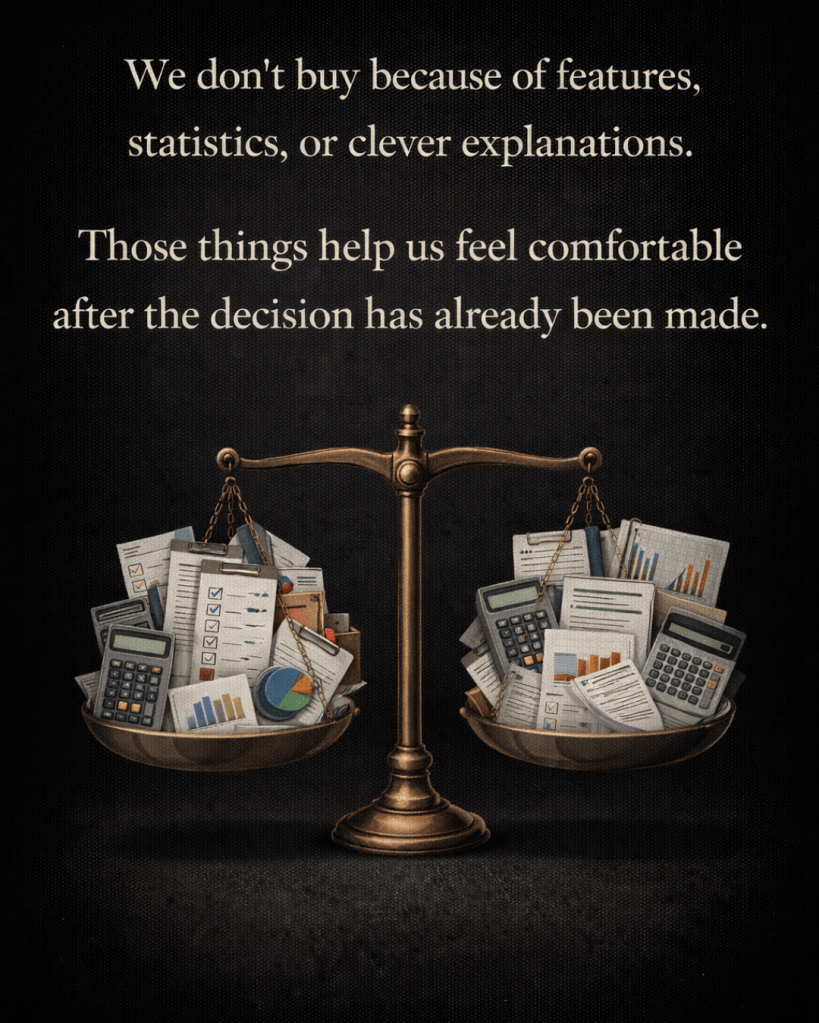
    We don’t buy because of features, statistics, or clever explanations. Those things help us feel comfortable after the decision has already been made.

    Desire leads. Logic follows.

    This is why over-explaining so often backfires. When we drown people in information, we assume we’re helping. In reality, we’re asking them to think when they’re wired to feel.

    People don’t need more detail.

    They need clarity.

    Clarity about why something matters.

    Clarity about how it fits into their world.

    Once that’s clear, the decision becomes simple.

  • The Win Happens Before the Win

    Most people look for success at the end of the process.

    They wait for the moment it all clicks — the result, the sale, the breakthrough, the confirmation that something worked.

    But by the time that moment arrives, the outcome has already been decided.

    The real work happens earlier. Much earlier.

    Wins are built in the routines we establish before there’s pressure. In the standards we set when enthusiasm is high. In the effort we’re willing to put in at the start, when results are still invisible.

    This is where most people get it wrong. They conserve energy early and expect momentum later. When things don’t move fast enough, they push harder — adding pressure where structure should have existed.

    Momentum doesn’t respond well to force.

    It responds to rhythm.

    When the beginning is intentional, the middle becomes easier and the end feels inevitable. When it isn’t, everything feels like uphill work.

    If you find yourself constantly having to “kick things back into life”, it’s worth asking: what did the start look like?

    Because growth rarely breaks down at the finish line.

    It breaks down at the starting blocks.

  • Expensive Is Often the Point

    Price is one of the most misunderstood signals in decision-making.

    It’s regularly treated as an obstacle, a barrier, something to be apologised for or explained away.

    But when it comes to things we want, price often does the opposite.

    A higher price communicates confidence. It signals quality, desirability, and status — often before we understand anything else about the product, service, or experience.

    We don’t want certain things despite their price.

    We want them because of it.

    The problem isn’t the number.

    It’s the story we attach to it.

    When price feels abstract, it feels heavy. When it’s broken down into real-world usage, it often becomes surprisingly light.

    We rarely question the small, habitual costs in our lives. Coffee. Convenience. Comfort. But we hesitate over things that promise real, lasting value — simply because we’ve labelled them “expensive”.

    Luxury feels indulgent in theory.

    It often isn’t in practice.

    Once value is understood, price stops being the villain.

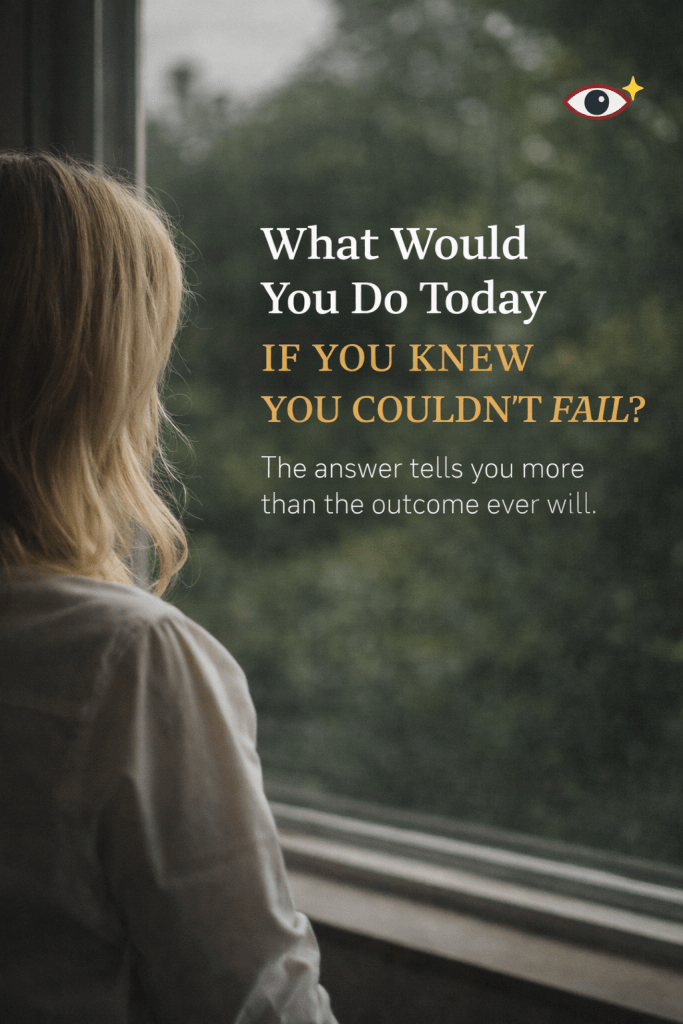
  • What would you do today if you knew you couldn’t fail?

    Today, I want to challenge you to reflect — really reflect — on how you review your own performance. After each call, day, week, month, or quarter… do you have a process?

    Every top performer in every industry has one thing in common: they fail. Then they fail again. And again.

    But most of us still attach negativity to that word: fail.

    Let’s flip that.

    F.A.I.L. = First Attempt In Learning.

    Things go wrong. Mistakes are inevitable. But the real difference is in how you respond.

    Think about it — we were all once babies. We couldn’t sit up, talk, or walk. And no one expects a toddler to get it right the first time. Falls happen (and have to happen) before a toddler actually toddles!

    Sure, parents can be in a rush to hit milestones. They’re competitive creatures — and trust me, I hated that part of parenthood…. other mums! They had a always have a knack of making you feel inadequate:

    “Mine walked at four months!” 🙄

    “Mine was talking at two months!” 🙄

    (As if!)

    Anyway — I digress. But let me ask you this:

    Did you ever once doubt that your child — or you — would eventually walk, talk, and grow into an adult?

    I’ve yet to see a town full of middle-aged people crawling around in nappies — Basildon aside (sorry Basildon, but who doesn’t love a good Essex joke?).

    The point is this: those early falls were critical. Each one taught us something new.

    Literally then — and metaphorically now.

    We need to carry that mindset into everything we do.

    Fail = Learn. And if you fail enough times, success becomes inevitable.

    Look at Alan Sugar, Duncan Bannatyne, Peter Jones, Richard Branson, Elon Musk… They all failed — often spectacularly — before they succeeded. James Dyson created 5,126 failed prototypes before building the one (number 5,127!) that became the bestselling vacuum cleaner of all time.

    He once said:

    “You never learn from success, but you do learn from failure.”

    But here’s the catch: you only learn if you take time to reflect.

    So, ask yourself:

    What did I do well today? What could I have done better? What else could I have done to be more productive?

    Start asking those questions — daily, weekly, monthly, quarterly, yearly.

    Self-review is vital for growth.

    So I’ll ask you again:

    What would you do today if you knew you couldn’t fail?

    Don’t wait. Go do it.

    Realign your thinking — because failure isn’t the opposite of success.

    It’s the path to it.

  • It ain’t what you do, it’s the way that you FRAME it!

    I thought I’d talk to you today about framing.

    Framing is all about how we look at things… how we present them… how we frame them! 

    Is a glass half full or half empty? 

    Take an empty glass and fill it half way: 88% will say it’s half full

    Take a full glass and pour half away: 31% will say the same 

    On a study where doctors considered the merits of surgery: 

    Those that were told 10 out of 100 died… 50% considered it a good option 

    Those that were told 90 out of 100 survived… 84% considered it a good option 

    Framing! Same data… presented differently completely changes our perception. 

    So consider your framing; it’s not the data… it’s how we present it that makes the difference. How are you presenting right now? And could you frame it better? 

    Here’s a thought: 

    1) you’re at a car boot sale: you see a vase you like… what do you expect to pay?

    2) same vase: mid range department store… what are you paying here? 

    3) it’s a 1-off at an exclusive antique store in Knightsbridge.. what would you pay? 

    I’m imagining your value is completely different in each of my scenarios? 

    Now consider: 

    1) boot sale vase… bet you’d never even put it on display (just when you receive a bunch of flowers out of the blue and have no other vessel) 

    2) department store vase… bathroom or kitchen display maybe? 

    3) Knightsbridge exclusive 1 off vase.. pride of place at all times right? 

    Same vase… our value for it completely changes based simply on framing! 

    The first time I wrote about this topic I was sat by a pool in Majorca surrounded by fake Gucci, Prada and YSL… and certainly right there the strength of framing hit me…

    Framing is vital: so always present yourself, your business, your product with the best content, with the most power and giving the maximum impact!

  • When it comes to sales: Our brain is wired to ‘run’!

    So today I’m talking about my favorite subject; listening! 

    Starting with the true basic of sales… the dreaded 2 ears 1 mouth quote. You should listen for twice as long as you talk…. Because we all know that the best sales people are good listeners rather than good talkers. 

    You need to put an end to conversational narcissism if you want to achieve more. 

    The spotlight should always come back to your client and I’ll tell you why. 

    (And surprisingly; it’s not just that we’ll find their hotspot if we let them talk and we listen more.. actually it’s even bigger than that).

    Have you all heard of the Amygdala

    It’s a part of our brain that sits in our temporal lobe within our limbic system that controls emotions and fear(It’s shaped like an almond .. no real relevance to that except Amygdala is Latin for Almond… in case you care!)

    Anyway; if you were on a little trek in the woods and a bear suddenly jumped out at you; before you could even say; ‘oh crap, that’s a bear’… your amygdala would be instantly alerted and this would trigger your fight, flight or freeze response! 

    When this happens it dampens down many other parts of your brain so it can focus single handedly on saving your skin. 

    One of the areas it disrupts is the prefrontal cortex; this is partially responsible for listening: it’s the part of your brain that puts everything together for the purpose of rational thinking and decision making. 

    So if we want our clients to hear us properly, think rationally and make a good decision; we need their Prefrontal cortex fully mobilised so we need that amygdala to pipe down! 

    Our amygdala is inactive and quiet when we feel safe and our prefrontal cortex is fully active under these conditions. 

    To feel safe; we don’t just need to be bear-free. Interestingly; studies have shown that when deeply held beliefs are challenged; this triggers the amygdala in exactly the same way as a physical threat would. So there is good reason to avoid; politics, religion and any such other strong beliefs in fact; anything controversial or confrontational! 

    To feel safe; we need to feel understood. 

    To feel safe; we need to feel that we matter & are important. 

    To feel safe; we need to feel listened to. 

    If we can put our clients in a position where they feel safe; then they are

    1) more likely to actively listen 

    2) less likely to be defensive 

    3) more likely think rationally

    4) more likely to make a good decision

    5) more likely to buy today 

    If we put our clients in a position where they don’t feel safe then their amygdala will be active and they will likely flit into fight, flight or freeze! 

    Remember how we ALL feel about sales people; we’re ALL scared that we’ll be tricked into buying something we don’t want… We all run when we see those clipboard people in the high street! 

    Are you a fight? – ‘I don’t need that, go away’

    Are you a flight? – ‘I’m sorry I’ve got to run, I’m late’ 

    Are you a freeze? – pretend to be on your phone! You know who you are!!! 😂

    So be aware that we’re often going in on the back foot… their amygdala is already alert as soon as they realise we are there to sell them something so what can you do today to dull that amygdala? 

    How can you ensure your client’s feel safe?

  • Self-improvement challenge: Vocal Image

    Communication is the greatest skill any of us could have in life: it means better relationship’s, friendships and the best communicators excel in all sides of life. 


    Communication is the most valuable skill that will enhance every part of our lives.
    So this week I’m asking you all to take a moment to consider your ‘Vocal Image’.

    We all spend a lot of time on our visual image; the way we look, the way we dress, our hair etc but have you considered your vocal image? What are you projecting? 


    We can change the way we look… Easy right? A change of clothes… lose weight, put on weight… surgery maybe… all possible… some easier than others but all possible. 

    But can you change your vocal image? I’ll ask you another question; is it possible to change a behavior? 
    Of course it is… although some behaviors are easier to change than others (just like our visual image) but again… all possible!


    The way you currently speak is simply a series of learnt behaviors. 
    We have this attachment to our natural ‘authentic’ voice… but I ask you to try playing with your voice: higher, lower, accent… be silly. You’ll feel silly and you’ll say ‘Heids, this isn’t me… it’s not my natural voice’.

    So again (my favourite word) reframe that thinking… You’ve already lost your ‘natural’ voice.

    The last time we all had our ‘natural voice‘ was at the age of 2 before we were impacted by external influences. The voice you have now is your habitual voice.. accents, projection, phrases, noises… all built based around the people we were surrounded by growing up. We’ve built ourselves a series of habits, a series of engrained behaviors. 
    It’s difficult to change because we’ve been replaying these behaviors for 10, 20, 30, 40, 50 years. But I ask you again… can we change behavior?… the answer is yes. 

    So consider your favourite speaker, actor, singer, performer… what makes them special? Do you have that showmanship? Let’s work on that….


    Changing your vocal image is absolutely possible:

    Step 1 is to detach yourself from the habit… realise that you just picked them up… you didn’t choose them… you adopted them… and randomly 

    Step 2 Be aware of what your habits are and which are serving you and which are limiting your potential(Do we all need the same accent?-no… but if our accent is so strong that it hinders other peoples comprehension then it’s limiting us so we need to work on our annunciation or pace to ensure we are effective communicators) 

    Step 3 Learn the more impactful habits that will serve us better and influence the people around us… this time build your habits with more intent  (leave random behind) 

    So how do YOU work on YOU? (You’ll likely hate me for this!)

    Record a 5 minute video of yourself on your phones… ideally standing up… and just speak. Don’t script… don’t plan… just speak. Any subject you like… not a work one because you want to see you natural. 


    Then I want YOU to review it… in 3 ways: 

    1) Turn the volume up… place the screen down on the table so you can’t see it and simply listen – conduct an AUDITORY REVIEW(Are you stuck in 1 volume, are you too quiet, too loud, emotion, pausing, speed??? Take notes) 

    2) 2nd time: Mute it and just watch yourself – conduct a VISUAL REVIEW (Movement; too little, too much, hand gestures, emotion, happy, grumpy, blank, visual ticks: playing with your hair/glasses? Take notes. 

    3) Then Have it transcribed (make sure you include the filler words and sounds you make) and complete a TRANSCRIPTION REVIEW. Print out the transcript and literally highlight all your filler words and noises. These are awful btw for your communication… they distract from your message, rob you of authority and lack clarity and credibility. You know the ones……’Errr, you know, err, like, and, you know what I mean, ummm, yeh, err, you know right, like, errr, right, like, errr and all that, and that, you know’.


    Once you’re aware of your verbal ticks: every time you hear yourself say one … it will be like an alarm bell in your head… you’ll drop them quickly and learn not to fill the silence… but use it!

    Remember, a pause is much more powerful than an ermmmm! 


    What this should show you is that; we can all improve our communication: it’s just a skill that we all can learn and develop by adopting new behaviors. 
    .

    What will you be working on? 

    Visually: hand gestures, movement, facial expressions, emotion

    Auditory: Pace, projection, volume, more vocal variety, energy

    Transcript-ally: vocal ticks, filler words, noises. 

    Let’s start this Friday with a plan to find our best selves and develop them! 

    And what better place to start…

  • Repetitive Messaging – The Ultimate Win

    Today I’m starting with a simple question: Have you ever considered why we repeated our times tables at school over and OVER again? (Do they still do that or am I merely showing my age?)

    We did it because our brains actually do not absorb information as well as most of us like to believe. In fact we only actually retain:

    5% of what we‘re told 

    10% of what we read

    20% of what we see and hear 

    30% of what we see through demonstrations

    50% of what we learn when engaged in group discussion

    75% of what we learn through practice 

    85% of what we learnt if we start implementing immediately

    90% when we teach someone else 

    What’s even scarier is that not only do we struggle to retain information but we don’t retain it for long… we forget it ridiculously quickly (we are unfounded giving goldfish such a hard time -a topic for another week 😉): Research shows that within 1 hour, learners forget an average of 50% of new information; within 24 hours, they forget an average of 70% of that information; and within a week, they forget up to 90% of what they learned! 

    So whether in sales, in training and throughout of business; how do we ensure that our message is absorbed and retained: 

    1. Tell stories – It’s been proven that after a presentation, 63% of attendees remember stories. Only 5% remember statistics *Chip Heath, Stanford Prof 
    2. Teach with laughter – Studies show that learning ability improves by 38.5% with laughter and delayed recall improves by 43.6% *Rey Auditory Verbal Learning Test
    3. Teach through Play – Research shows that when mammals play, their brains are activated in a way that can change the connections in the prefrontal cortex that impact emotional regulation and problem-solving. Play also triggers the release of chemicals in the brain (such as oxytocin and dopamine) that help to; support social skills; impact mood, memory, motivation, and attention
    4. Use as many tools as possible – audio, visual, props, hands on, games, stories, etc 
    5. Encourage immediate action – start using immediately/train a team member etc
    6. Repetition is key – be ready to repeat yourself. It’s not dull to them as they’ve likely forgotten 90% of it!

    How can you use this information to build your success?